
Securing the Spotlight: Security and Surveillance Considerations for Pitman’s Proposed Americana Studios District
A $450 million vision is taking shape on Pitman’s former Sony plant site. Americana Studios District aims to transform the roughly 76-acre property into a mixed-use destination that blends Hollywood-style production facilities with housing, retail, dining, public gathering spaces, and a living museum. Soundstages designed with an old-world movie-lot aesthetic would sit alongside walkable village streets, outdoor amphitheater-style screening areas, a large commissary, and residential neighborhoods.
While the project remains in early stages—following the recent signing of a redevelopment agreement—its scale and hybrid character raise important questions about security and surveillance. A development that invites the public into some areas while protecting high-value production assets, intellectual property, and residential privacy will require carefully layered protections.
Project details in this post come from the Borough of Pitman press release (Oct. 26, 2026) and 42 Freeway. The security and surveillance ideas below are general design considerations, not part of the announced plan.
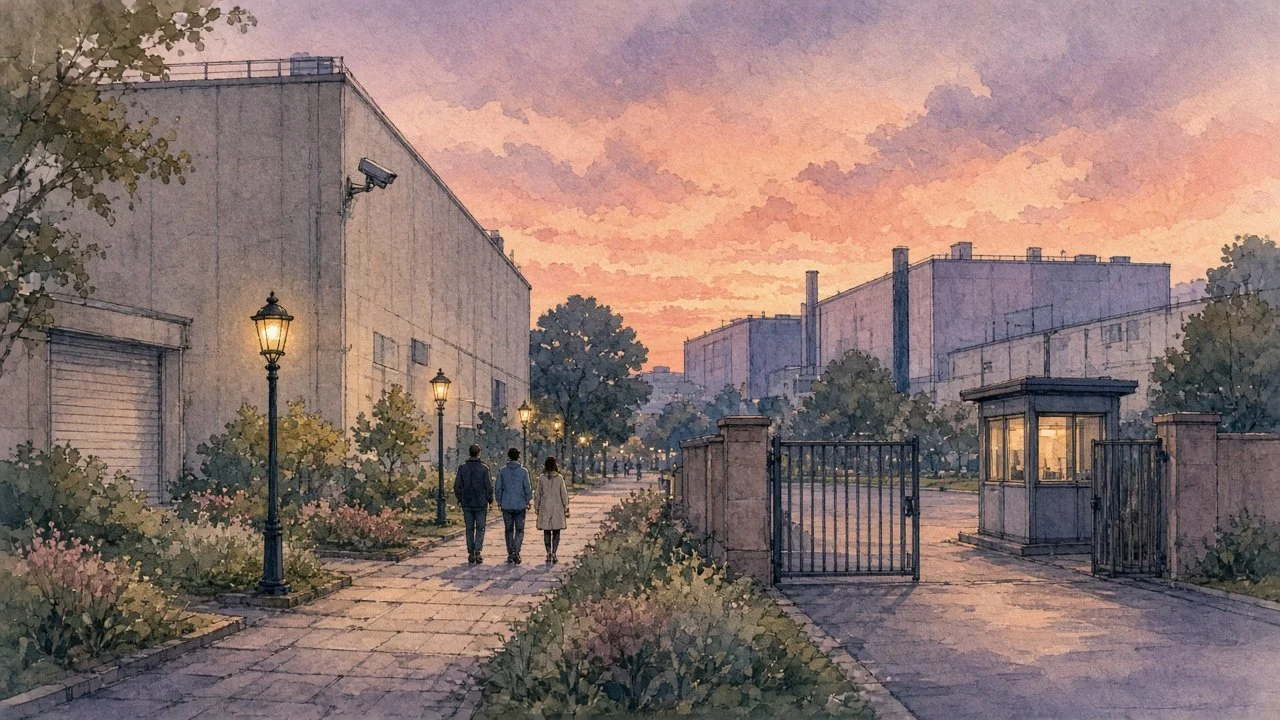
Illustrative image of a studio campus entrance. This is not a rendering of Americana Studios District.
Balancing Open Access with Controlled Environments
One of the project’s defining features is the intentional overlap between public and private space. Presenters have described opportunities for visitors to access a large commissary, view certain production activities in theater-like settings, and enjoy landscaped walkways, outdoor seating, cascading water features, and gathering areas. At the same time, the core production campus would remain separate from unrestricted public access.
This dual nature creates distinct security zones. Public-facing areas need approaches that feel welcoming rather than fortress-like—visible but non-intrusive cameras, good lighting, clear sightlines, and trained staff. Production areas, by contrast, will demand tighter controls: badge or biometric access, vehicle checkpoints, restricted-entry soundstages, and monitoring systems capable of protecting equipment, sets, and unreleased content.
The residential components (condos, townhomes, and single-family homes) add another layer. Residents will expect privacy and safety comparable to any well-managed neighborhood, even as the broader site hosts visitors, production crews, and events.
High-Value Assets and Intellectual Property
Film and television production involves expensive cameras, lighting, sound equipment, props, and digital assets. Scripts, dailies, and finished content represent significant intellectual property. Soundstages and support buildings will need robust physical security—hardened perimeters, secure storage, and continuous monitoring—alongside cybersecurity measures that protect editing systems, media servers, and network infrastructure.
Because the site is proposed as a year-round destination rather than a closed industrial campus, the boundary between “studio” and “public” will need clear demarcation and reliable enforcement. Any public viewing areas or shared dining facilities will require protocols that prevent unauthorized photography, recording, or access to sensitive zones.
Crowd Management, Events, and Public Safety
Renderings and descriptions point to outdoor gathering spaces, an amphitheater-style setting with a large covered screen, and retail and restaurant amenities expected to draw regional visitors. These features introduce classic event-security considerations: crowd flow, emergency egress, vehicle access and parking control, and coordination with local emergency services.
Proximity to wetlands and proposed walking trails adds environmental and perimeter-monitoring needs. The overall site’s size and its location near major roadways will also influence traffic management and access-point design.
Potential Surveillance and Technology Needs
Modern mixed-use entertainment and production districts typically rely on integrated systems rather than isolated cameras. Likely considerations for a project of this type include:
Layered video surveillance covering public plazas, parking areas, building exteriors, and key internal production zones, with analytics capable of detecting unusual activity while respecting privacy expectations in residential and public spaces.
Access-control systems that differentiate between residents, employees, production personnel, vendors, and day visitors.
Perimeter security that can adapt to the site’s mix of open village frontage and more controlled production and residential sections.
Centralized monitoring that supports both on-site security teams and coordination with Pitman and Gloucester County public-safety agencies.
Cybersecurity architecture protecting production networks, building management systems, and any guest or residential connectivity.
Thoughtful design can make many of these measures less visible. Landscaping, architectural details, and careful camera placement can support safety without creating an overly institutional atmosphere—especially important given the emphasis on an inviting, walkable aesthetic.
Looking Ahead
Americana Studios District is still a proposal. Significant planning-board, environmental, and other approvals remain, and no construction timeline has been announced. As details firm up, security and surveillance planning will need to evolve alongside the master plan. Early integration of these considerations—rather than treating them as afterthoughts—can help the project deliver both the creative and community benefits its backers envision while protecting people, property, and intellectual assets.
A successful district of this kind will need to feel open and vibrant to visitors and residents while remaining secure for the high-stakes work of film, television, and recording production. Getting that balance right will be one of the quieter but essential challenges facing the development team as the Pitman project moves forward.
Richard Sanford, RA / Dauntless Design Collaborative, Williamstown, NJ